

Why is Business Risk the Elephant in the Room?
Most SME owners focus on growth, customers, and cashflow, but few talk about risk, the elephant in the room that’s obvious yet often ignored until it’s too late.
Risk isn’t just about disasters; it’s about uncertainty, late payments, cyberattacks, compliance changes, or supply failures that can quietly destabilise a business.
Ignoring risk doesn’t remove it; it just leaves you unprepared.

The “elephant in the room” … the risks everyone senses but few openly discuss.
The Elephant We Don’t Talk About
I’ve spent many years discussing business issues with SME owners. In my experience, SME owners dream about growth, customers, and cashflow. But few talk about risk. It’s the elephant in the room - obvious, enormous, and often ignored until it becomes impossible to miss.
For SMEs, risk isn’t just about disasters or bad luck. It’s about uncertainty, the unpredictable events that can derail performance, cashflow, and/or reputation. Larger companies have risk officers and committees. SMEs have instinct and hope. That’s courageous, but it’s not strategy.
Ignoring risk doesn’t protect you from it. It just means you’ll be less prepared when it strikes.
The Reality: Risk Is Everywhere
Every decision carries some level of risk:
A key customer pays late.
A cyber-attack locks your files.
A compliance rule changes overnight.
A supplier can’t deliver.
Individually, these may be small setbacks. Together, they can destabilise your business. Most SMEs only start managing risk after they’ve been hurt by it, for example, a late payment, a data breach, or an unexpected tax penalty.
But with a structured risk-management process, you can identify threats early, limit damage, and even uncover opportunities.
So, Why Do We Avoid the Topic?
Many business owners sidestep risk discussions for three reasons:
Perception: Risk sounds negative. It feels like a distraction from growth.
Complexity: Formal risk frameworks look corporate, full of jargon and scoring grids.
Time: It never feels urgent - until it’s too late.
Yet risk management is not about avoiding growth; it’s about protecting it. The same process that helps you reduce uncertainty helps you make smarter, more confident decisions.
A Simple Five-Step Risk Management Process for SMEs
You don’t need a thick manual or a corporate department. Just a repeatable five-step cycle:
1.Identify Risks
List everything that could stop your business achieving its objectives. Group them by category, for example, strategic, operational, financial, compliance and legal and cybersecurity.
2. Assess Risks
Score each risk for likelihood (the chance that the risk will occur) and impact (how will it impact your business). Prioritise those that could cause serious disruption even if they’re unlikely.
3. Mitigate or Respond
Decide what actions you should take. These generally include:
1. Avoid: Take deliberate action to eliminate the risk entirely, either by removing its cause or choosing an alternative course of action.
e.g.: Cancel a project to prevent potential losses.
2. Reduce: Implement measures to lower the likelihood or impact of a risk to an acceptable level to your business.
e.g.: Introduce staff training to reduce the chance of an incident occurring.
3. Transfer: Shifting the financial or operational consequences of a risk to another party, often through contracts, insurance, or outsourcing.
e.g.: Purchase business insurance that assumes responsibility for specific risks.
4. Accept: Acknowledge and tolerate the risk when the cost of mitigation exceeds the potential loss, or when the risk is minor and within your business’ risk appetite (the amount of risk your business is prepared to accept).
5. Monitor and Review
Risks grow and change. It’s a good idea to undertake a regular review or when your business model changes. Create a risk register recording the risks identified and your intended action. What gets measured gets managed. Update your risk register to reflect new realities.
6. Report and Communicate
Discuss risks openly with staff and other stakeholders. Shared awareness creates accountability and results in fewer nasty surprises.

“The Unseen Pressure Of Risk On Business…”
Turn Risk into an Advantage
Effective risk management isn’t a cost; it’s a competitive advantage. It reassures lenders and investors, strengthens strategy, and improves resilience.
The SMEs that survive economic shocks, cyber-threats, and regulatory change aren’t lucky, they’re prepared. They know their vulnerabilities and act before cracks appear.
At Avenor Solutions, we’ve built Excel-based risk-management templates that turn complex frameworks into easy-to-use dashboards. Our tools help SMEs assess, score, and mitigate risks — without needing corporate resources or consultants.
Face the Elephant
Risk will always exist. But when you make it visible, you make it manageable.
Risk management is not a “one size fits all” approach. You need to craft it to your specific needs and circumstances.
By adopting a simple risk-management process, you protect your business, your team, and your future. The elephant in the room only feels intimidating until you shine a light on it.
Face the elephant. Control the risk. Protect your future.
Follow or share Avenor Solutions:
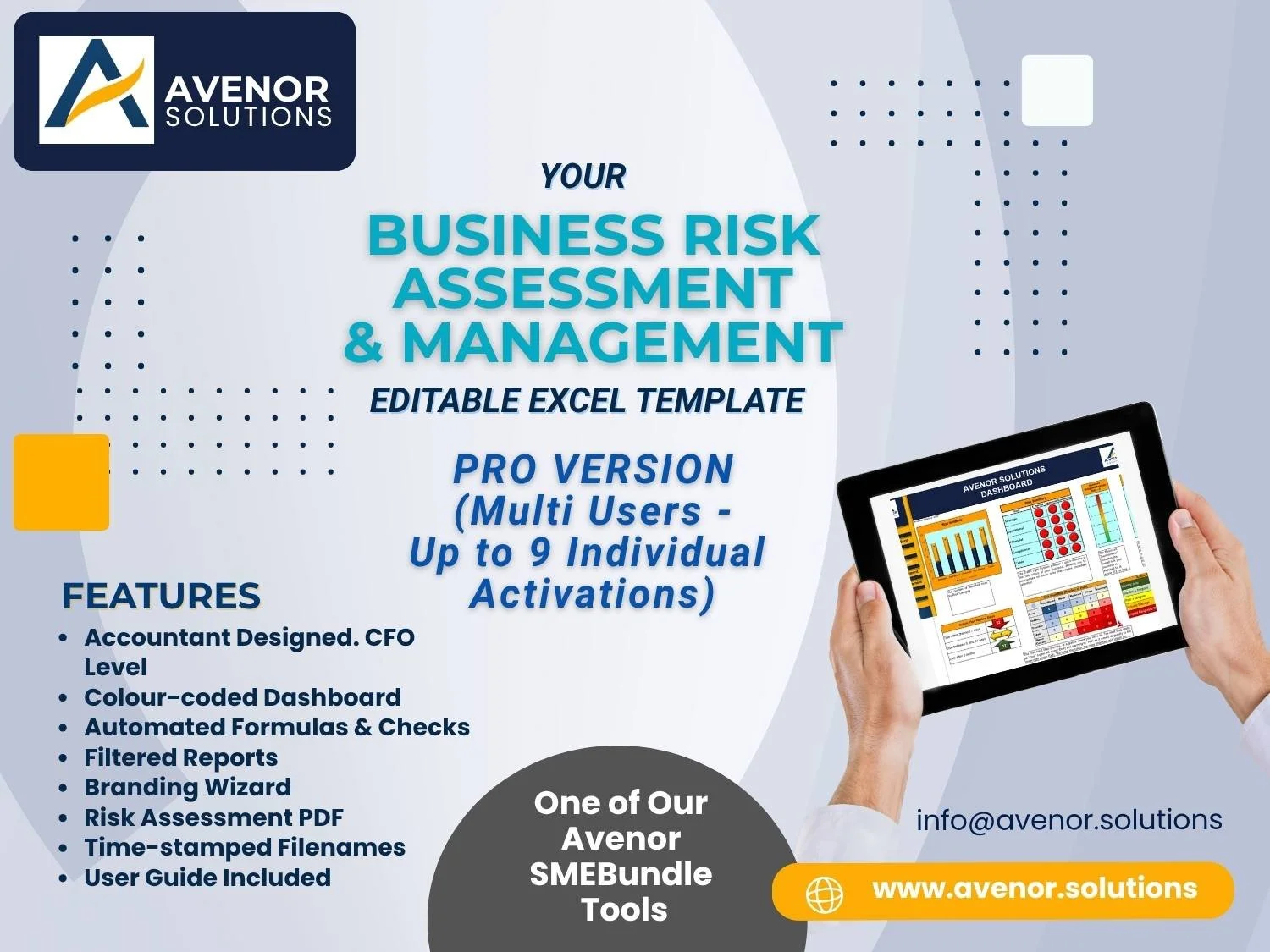
Effortless Tools At Your Finger Tips
Click on the “Go to Related Products” link above to take a look at the Standard and Pro versions of our Risk Assessment tools for your business.